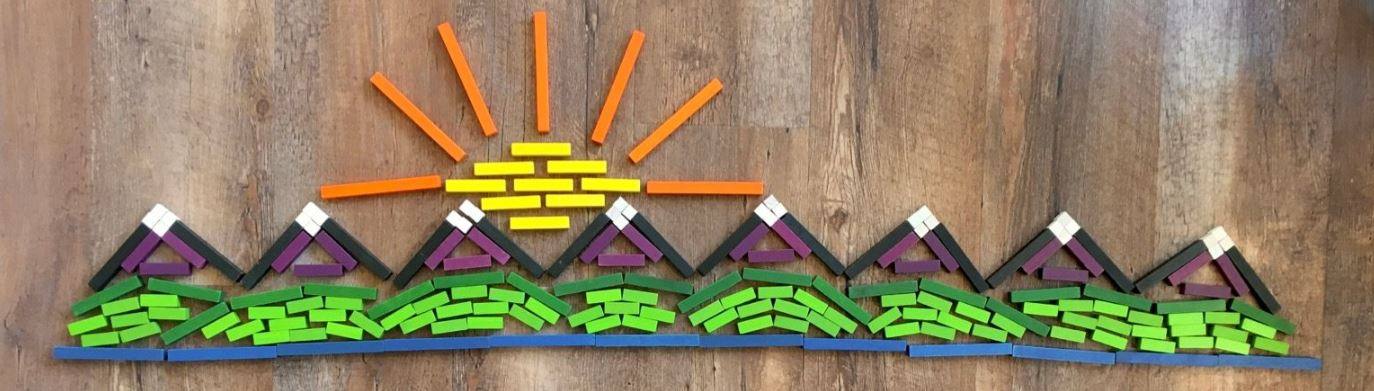
Build & Learn: Cuisenaire Rod Structures
Build and Learn: Cuisenaire Rod Structures is a hands-on, discovery-based mathematics course that helps children develop deep mathematical understanding through pattern, relationship, structure, and play. Students explore equivalence, transformations, missing rod structures, staircases, trains, mats, operations, fractions, area, multiplication, division, and early algebraic thinking long before formal procedures are introduced, using Cuisenaire rods as visual and tactile tools.
We built this course around noticing, wondering, building, comparing, testing ideas, and discovering relationships. Students learn to see how mathematical structures behave, how patterns stay the same or change, and how different representations connect to one another.
Throughout the course, parents guide students through carefully sequenced video lessons, demonstrations, games, and exploratory activities that help them move from concrete experiences to symbolic understanding naturally and meaningfully. Parents are also taught how to observe thinking, ask productive questions, and support learning without over-explaining or interrupting discovery.
The course is grounded in the Notice–Wonder–Discover framework and integrates cognitive skill development from the Pattern Hunter’s Toolkit and From Here to There. Students strengthen skills such as attention and observation, spatial reasoning, comparison and classification, sequencing, systems thinking, logical reasoning, flexibility, and communication while engaging with rich mathematical ideas.
Topics explored throughout the course include:
- Exploring trains, staircases, and rod relationships
- Equivalence and missing rod structures
- Addition, difference, multiplication, and division relationships
- Transformations and invariance
- Area models and rectangle thinking
- Fractions, factors, multiples, and proportional reasoning
- Pattern recognition and systems thinking
- Mathematical language and symbolic representation
- Flexible problem solving and strategy development
Students are encouraged to think, talk, build, test, revise, and communicate their ideas rather than simply follow procedures. Even advanced concepts like long division are introduced through meaningful structures students already understand, such as area models and rectangles, helping them build conceptual understanding instead of memorizing disconnected steps.
Build and Learn: Cuisenaire Rod Structures is designed for families who want more than “getting through math.” It is for parents who want to cultivate thoughtful, observant, flexible learners who can recognize patterns, make meaningful connections, and approach new ideas with confidence and curiosity.
71 Lessons
Already Joined? Login